Most eCommerce brands operate on a dangerous assumption: that the first sale is the goal. In reality, focusing solely on acquisition is the fastest way to erode your Shopify profit margins and trap yourself on an endless growth treadmill.
If your business model relies on “one-and-done” customers, you aren’t running an eCommerce brand—you’re running a cash-flow drain. You pay to acquire a customer, break even, and then scramble to find a new one to replace them. That’s not scaling. That’s bleeding.
The Retainency philosophy is built on a simple, brutal truth: You don’t make profit until the second purchase. When a customer buys for the second time, your Customer Acquisition Cost (CAC) is effectively amortized. The second order is almost pure margin. But you cannot sit back and “hope” they come back. You have to be aggressive. You have to engineer the second purchase. If you are struggling to maintain your margins, you are likely falling into one of these three traps.
Mistake #1: Generic Cross-Sells That Destroy Shopify Profit Margins
The Flaw: Treating cross-selling as a volume game.
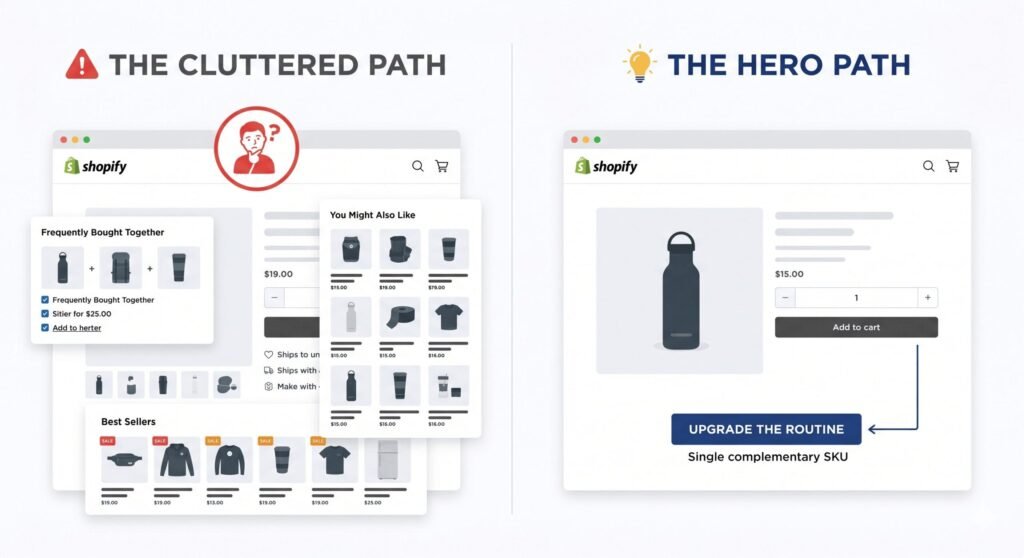
Many store owners think that showing the customer “more products” is the key to a higher Average Order Value (AOV). So, they install a generic “Frequently Bought Together” widget that displays random, irrelevant items. When a customer buys a high-end skincare serum, the site suggests a random lip balm because the algorithm saw a weak correlation.
This is a conversion killer. It clutters the UI and presents the customer with too many choices, leading to “analysis paralysis.” You are distracting them from the most logical next step.
The Fix: The “Hero Product” Path Stop cross-selling everything and start mapping the Hero Path.
Use your Shopify sales data to find the specific SKU that has the highest correlation with a second purchase. If data shows that 40% of your customers who bought Product A eventually bought Product B, stop pushing anything else.
Create a dedicated post-purchase flow that only introduces Product B to Product A buyers. Do not offer a discount yet; offer education. When you focus the cross-sell on the “proven second step,” you remove friction and make the next purchase feel like the natural progression, not a sales pitch.
Mistake #2: The “Dead-End” Email Trap Hurting Shopify Profit Margins
The Flaw: Sending generic, soulless “Thank You for Your Order” emails that lead to dead ends.
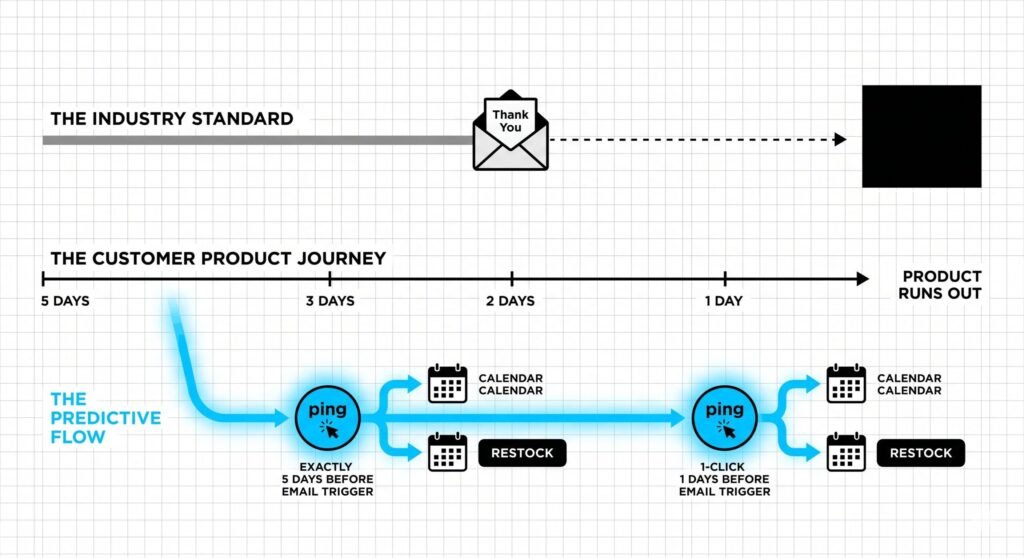
If you sell consumables, your biggest opportunity for profit lies in the replenishment cycle. Yet, most brands send a transactional email that essentially says, “We got your money, bye.”
This is a massive margin leak. Every day that passes after that email without a strategy to get them back is a day they are drifting toward a competitor or Amazon.
The Fix: The “Replenishment Trigger” Pivot If your product has a lifespan (skincare, supplements, pet food), stop guessing when they will run out. Stop sending “generic” emails and start sending “predictive” ones.
Use your RFM (Recency, Frequency, Monetary) data to automate a Replenishment Flow.
- The Cadence: Send the first email 5 days before they are projected to run out.
- The Hook: Do not just say “Buy again.” Say: “Hey [Name], your supply of [Product] is likely running low. Here’s a 1-click link to restock.” It’s not marketing; it’s inventory management. By acting as an assistant rather than a salesperson, you solve a problem for them before they feel the pain of running out. That is how you capture the second order with zero friction.
Mistake #3: Wasting the Unboxing Experience (and Your Shopify Profit Margins)
The Flaw: Wasting the physical delivery experience.
The physical delivery of your product is the most underrated marketing channel you have. Your customer is excited to open that package, this is the point of peak engagement. Ignoring this moment is like paying for a billboard on a busy highway and leaving it blank.
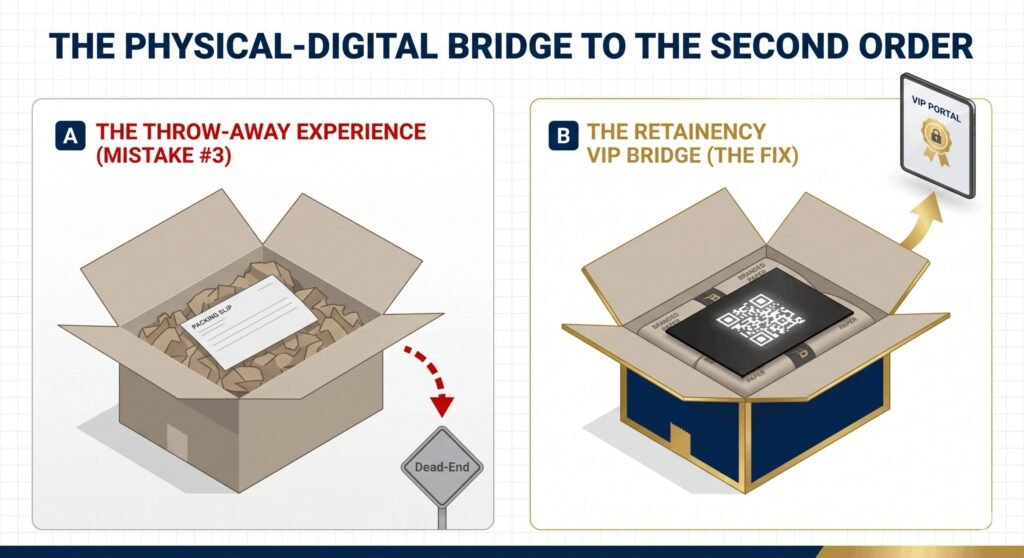
Most brands treat the unboxing experience as a utility: a cardboard box, some bubble wrap, and a packing slip. They miss the opportunity to bridge the gap between the physical product and the digital retention loop.
The Fix: The “Unboxing” Upsell Bridge Don’t just put a packing slip in the box. Use a high-quality, branded insert card with a QR code. But do not link to your homepage. That is a mistake; the homepage is for new customers, not existing ones.
Link that QR code to a “Private VIP Portal” where they can unlock an exclusive “Second-Order-Only” offer.
- Why it works: You are capturing them at the exact moment they are experiencing your brand’s quality. They are holding your product in their hand, they are happy, and they are listening. By giving them a VIP-only destination, you make them feel like an insider. This is how you force a second order through the physical-to-digital bridge.
The Bottom Line: Engineering Retention
Profitability in 2026 isn’t about running faster ads; it’s about holding onto the customers you already have. If your current strategy is to “acquire, sell, and forget,” your margins will continue to erode as ad costs rise.
You must stop viewing the post-purchase experience as a “bonus” and start viewing it as the primary engine of your business.
- Stop cluttering the path: Focus on the “Hero Path.”
- Stop the dead ends: Use predictive replenishment.
- Stop wasting the unboxing: Bridge the physical to the digital.
Fix these three brutal mistakes, and you won’t just see a boost in your repeat order rate, you’ll see an increase in the one metric that actually matters: Net Profit.
Ready to start? Let’s look at your current post-purchase flow. Is it an engine, or is it a dead end?