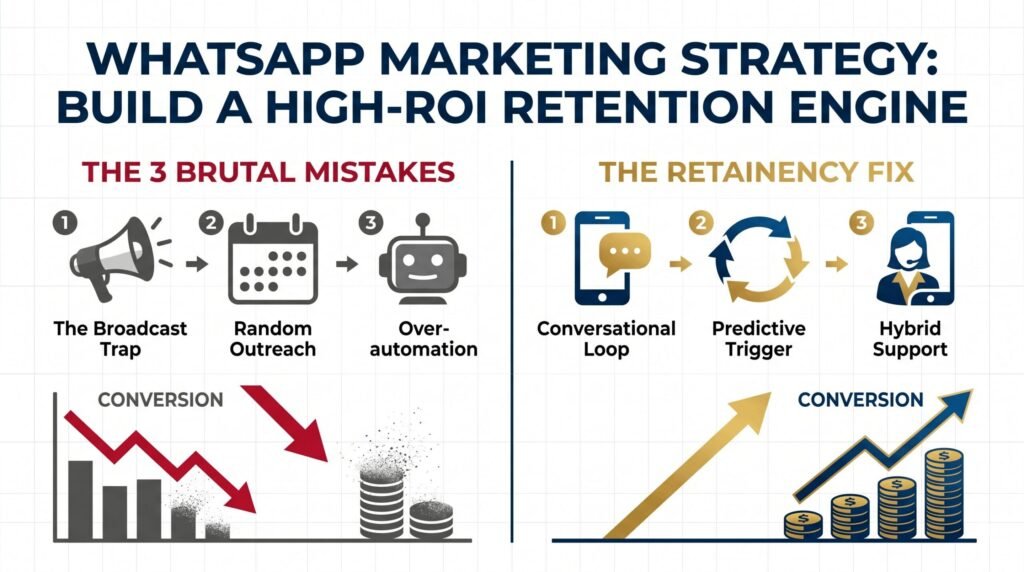
Most e-commerce brands in the GCC and beyond are failing to implement a profitable WhatsApp marketing strategy. Instead of building a relationship, they treat this powerful channel like a low-cost version of an email newsletter, a digital billboard where they blast discount codes to thousands of people at once and pray for a conversion. This approach is not just ineffective; it is dangerous. It is the fastest way to get your business account blocked, reported, and ultimately ignored.

In regions like the Middle East, WhatsApp isn’t just a communication app; it is the primary operating system for daily life. When you spam your customers, you aren’t just annoying them; you are intruding on a personal, sacred space. That is a violation of trust, and in retention marketing, trust is the only currency that matters.

The Retainency philosophy for WhatsApp is not about broadcasting; it’s about Conversational Commerce. If you want to move away from “spam” and build a high-performance retention channel, you need to stop sending messages and start building a relationship.

If your current approach involves “Blast All” buttons, you are leaking profit. Here is how you engineer a WhatsApp Retention Engine that actually converts.

Infographic: Comparing a chaotic 'Broadcast Trap' with a block of text to a clean conversational 'Hook-and-Response' WhatsApp flow.

The WhatsApp Marketing Strategy Shift: From “Broadcast” to “Conversational”

To understand the shift, you must understand the platform. Email is asynchronous; it sits in a pile. WhatsApp is synchronous; it demands immediate attention. When you send a wall of text that looks like a marketing brochure, the customer’s brain instantly filters it as “noise.”

Conversational Commerce is about moving away from the “One-to-Many” broadcast model and embracing the “One-to-One” relationship model. The goal of a WhatsApp marketing strategy is to make your brand feel like a contact in their phone, not a corporation in their inbox.

Data visualization: A timeline showing 'The Industry Standard' random sale blasts compared to 'The Retainency Fix' of automated WhatsApp reminders triggered 3 days before product depletion.

Mistake #1 in Your WhatsApp Marketing Strategy: The “Broadcasting” Trap

The Flaw: Using WhatsApp as an alternative to email.

Many brands treat WhatsApp marketing like an email blast. They craft a 500-word paragraph, paste a stock image, and hit “Send All.” This ignores the fundamental nature of the channel. WhatsApp is immediate, personal, and brief. When you send a wall of text, you trigger the “marketing fatigue” response.

The Fix: A “Hook-and-Response” WhatsApp Marketing Strategy Loop

Shift your architecture to a “hook-first” model. Your message should never be the destination; it should be the invitation.

Once the customer replies, the WhatsApp algorithm flags the thread as a “high-priority conversation.” This does two things:

  1. Deliverability: Future messages from you are significantly more likely to be delivered and read because you are now a “trusted contact.”
  2. Data Capture: You are now engaging in a two-way dialogue, which allows you to tag the customer’s intent (e.g., “Ready to Switch,” “Not Interested,” “Needs Help”).
Infographic: Contrasting a generic chatbot menu with a dynamic flow that detects high-intent keywords and automatically transfers the user to a human WhatsApp support agent.

Mistake #2 in Your WhatsApp Marketing Strategy: Random Outreach vs. Predictive Replenishment

The Flaw: Relying on manual follow-ups or generic “Buy Again” blasts.

If you sell consumables skincare, supplements, pet food, or coffee your customers have a natural, predictable repurchase cycle. Most brands ignore this and only reach out when they have a store-wide sale. They are leaving thousands in revenue on the table because they aren’t timing their touchpoints to the customer’s actual lifecycle.

The Fix: The “Predictive Trigger” WhatsApp Marketing Strategy Architecture

Stop guessing and start calculating. Integrate your Shopify order history directly with your WhatsApp Business API. Create an automated flow that triggers exactly 3 days before a product is estimated to run out.

By acting as a concierge rather than a salesperson, you remove the friction of the checkout process. This isn’t marketing; it’s inventory management for your customer. Utility is the highest form of retention.

Technical diagram: A central 'WhatsApp Retention Engine' supported by three interconnected architectural pillars: Data Sync, Compliance Opt-ins, and Dynamic Segmentation.

Mistake #3 in Your WhatsApp Marketing Strategy: Over-Automating and Losing the Human Touch

The Flaw: Deflecting all inquiries to a chatbot to save money.

Bots have their place, but they shouldn’t handle everything. Many e-commerce stores try to deflect all inquiries to a chatbot to cut overhead. This is a massive mistake. When a customer has a legitimate question about a product, shipping, or ingredients, they want a human, not a pre-programmed script.

The Fix: The “Hybrid Support” Model

Use your support team to close the loop on high-intent leads. You don’t need a massive team; you need a smart routing system.

Technical Execution: How to Build Your Retention Engine

A successful WhatsApp marketing strategy isn’t just about the words you send; it’s about the plumbing behind the scenes. To scale this, you need to treat your WhatsApp channel like a core business asset.

1. Unified Customer Profile

Ensure your WhatsApp platform is synced with your Shopify backend. You should not be asking a customer for their email address if they have already provided it at checkout. Use hidden UTM parameters and customer IDs to bridge the gap between their WhatsApp number and their Shopify profile.

2. Compliance and Opt-ins

Never, ever use cold lists. In the GCC and globally, WhatsApp is strict on compliance. Ensure your opt-in process is explicit and transparent. Use “Click-to-WhatsApp” ads on Instagram and Facebook that lead directly to a pre-filled message, ensuring that the customer initiates the conversation. This drastically improves your “Quality Score” with Meta.

3. Segmentation is Survival

Stop sending one message to your entire list. Segment your audience based on:

When you send a hyper-relevant offer to a segmented list, your conversion rates will outperform generic email blasts by 3x to 5x every single time.

The Bottom Line: Engineering Trust

WhatsApp Marketing for e-commerce is about intimacy at scale. The goal isn’t to blast your way to revenue; it’s to earn a permanent spot on your customer’s home screen.

If you follow these three rules Conversational over Broadcasting, Predictive over Random, and Human over Bot you won’t just increase your repeat purchase rate. You will build a moat around your brand that competitors simply cannot cross.

Ready to turn your WhatsApp channel into an engine? Stop looking at it as a marketing tool and start treating it as a retention machine. It’s time to move beyond the blast, get into the conversation, and start serving your customers the way they deserve.

Schedule A Free Audit
Read More