
- Why Your Current PMax Strategy is a "Leaky Bucket"
- The "Force Multiplier": Integrating First-Party Retention Data
- Step-by-Step: Implementing a Value-Based PMax Strategy (VBB)
- The Math of a 20x ROAS PMax Strategy: Looking Beyond the First Click
- Conclusion: Does Your PMax Strategy Talk to Your Retention Engine?
The “growth-at-all-costs” era is officially over, and if your current PMax strategy isn’t evolving, your margins are likely dying.
If you run a Shopify store, you’ve seen it:
Your Shopify ROAS looks great on the dashboard, but your bank account is stagnant.
The truth is, most standard PMax strategies are designed by Google’s AI to find “cheap” clicks rather than “profitable” customers.
Google’s algorithm is a volume hunter that defaults to a PMax strategy of finding one-time shoppers and discount-seekers.
At Retainency, we call this the “Volume Trap.” But what if you could “force” your PMax strategy to ignore the junk and only bid on high-value users?
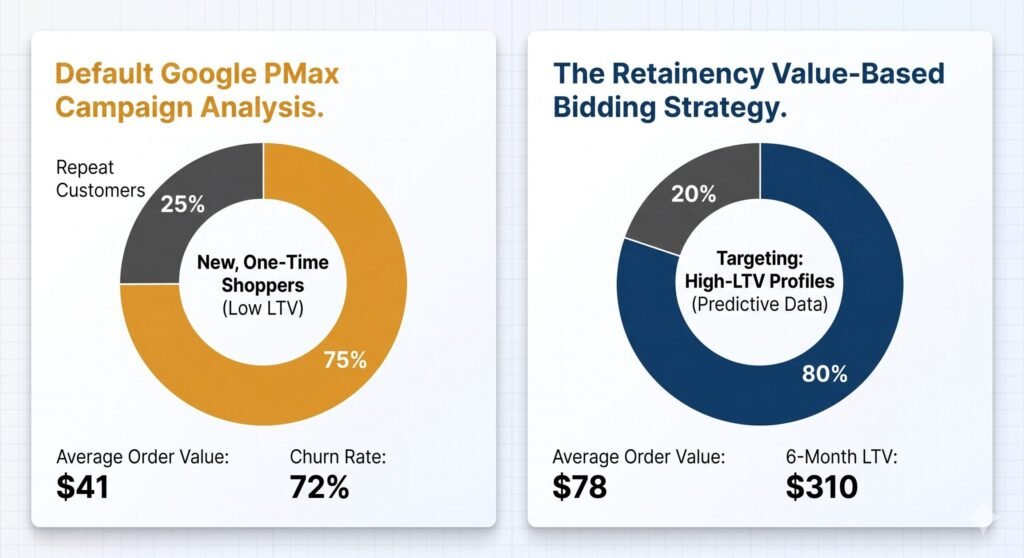
That is the power of Value-Based Bidding. By syncing your first-party data with a sophisticated PMax strategy, you stop “renting” customers and start owning a profitable market.
Why Your Current PMax Strategy is a “Leaky Bucket”
Performance Max is powerful.
But it has a “blind spot.”
By default, Google’s AI treats every conversion the same.
It doesn’t care if a customer spends $50 and returns the item tomorrow.
It doesn’t care if they only buy because of a 40% discount code.
Google just wants the “win.”
The result? You end up with a high Shopify ROAS on paper but a “leaky bucket” in reality.
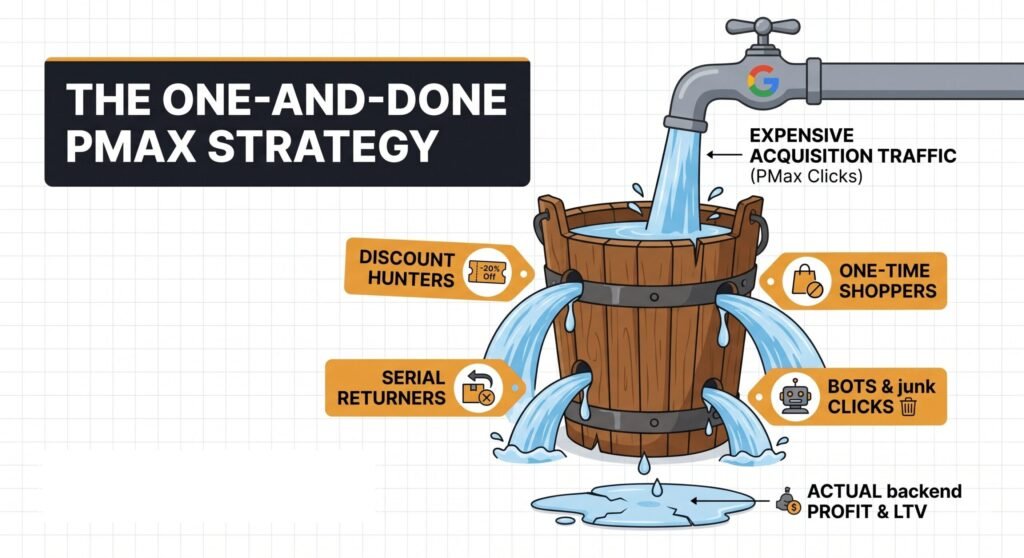
The “One-and-Done” Trap
When your PMax strategy focuses only on volume, you attract “bottom-feeder” traffic.
These are shoppers with zero Lifetime Value (LTV).
They buy once. They never come back. And your Customer Acquisition Cost (CAC) eats your entire margin.
This is where most eCommerce retention strategies fail. They try to fix the problem after the customer has already left.
The Optimization Blind Spot in your PMax Strategy
If you don’t feed Google the right data, it defaults to the path of least resistance.
It finds the cheapest clicks that lead to a “Purchase” event.
But at Retainency, we know that not all “Purchases” are created equal.
To fix the leak, you have to stop optimizing for the transaction. You have to start optimizing for the relationship.
That starts with first-party data.
The “Force Multiplier”: Integrating First-Party Retention Data
Most marketers treat Google Ads like a black box.
They feed it basic signals. They get basic results.
But if you want to see a 20x ROAS, you need to give the AI an “unfair” advantage.
You need to feed it your First-Party Data.
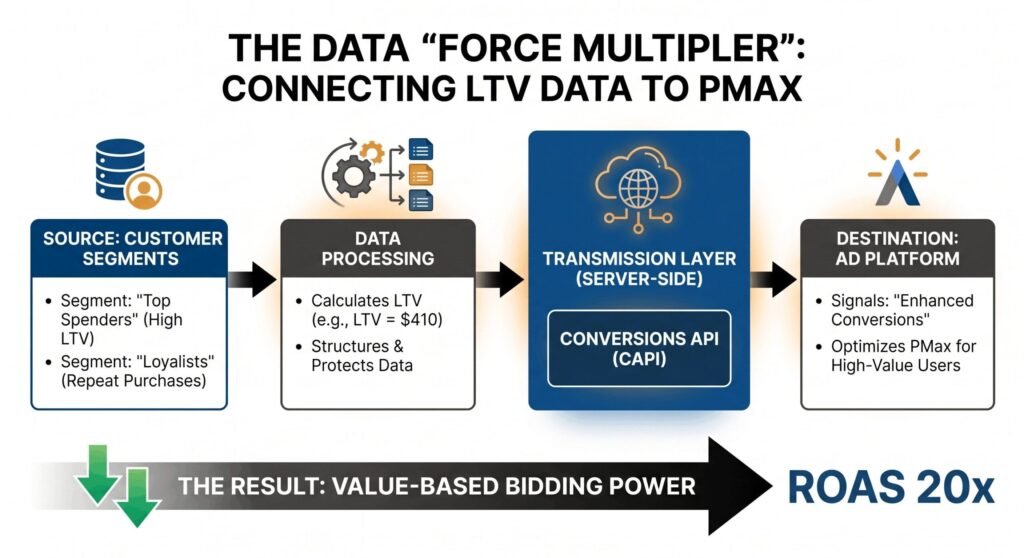
The “Retainency” Secret: Connecting Klaviyo LTV Segments to Google
In 2026, the standard “Pixel” is a dinosaur.
It only see what happened. It doesn’t see who it happened to.
By syncing your Klaviyo “Whale” segments your customers with the highest Lifetime Value (LTV) directly into your PMax strategy, you change the rules.
Instead of searching for “anyone with a credit card,” Google starts searching for “people who spend like your best customers.”
Feeding the Beast: How the Conversions API (CAPI) Changes Everything
Here is a technical truth:
Cookies are dying. Tracking is getting harder.
This is where the Conversions API (CAPI) comes in.
CAPI creates a server-to-server connection between your Shopify store and Google. It bypasses ad blockers. It ignores browser restrictions.
The result? Better data matching. Lower Shopify ROAS discrepancies.
When your acquisition engine knows exactly who your repeat buyers are, it stops guessing.
It starts winning.
Step-by-Step: Implementing a Value-Based PMax Strategy (VBB)
Now, let’s get tactical.
Most people set their PMax goals to “Maximize Conversions.”
That’s a mistake.
If you want to force a 20x ROAS, you need to use Value-Based Bidding (VBB).
Here is exactly how we do it at Retainency.
Step 1: Identifying your “Whale” Segments in Shopify
Don’t treat all customers as equals.
Go to your Shopify Analytics. Look for your top 10% of customers by Lifetime Value (LTV).
What do they have in common?
- Do they buy specific products?
- Do they skip the discount codes?
- Do they have a high “purchase frequency”?
Once you identify these “Whales,” you create a custom audience. This is your “Gold Standard” for Google’s AI.
Step 2: Assigning “Predictive Value” to New Leads
Here is the “Secret Sauce.”
Instead of waiting 6 months to see if a customer is valuable, we use predictive value.
If a new customer buys a “Hero Product” known for high retention, we tell Google that conversion is worth 3x more than a standard sale.
We feed this data through the Conversions API.
Now, Google’s algorithm is incentivized to find that specific type of buyer.
Step 3: Setting the tROAS Floor for High-LTV Growth
Now, you switch your PMax strategy to Target ROAS (tROAS).
But be careful.
If you set it too high, you kill your reach. If you set it too low, you get junk.
At Retainency, we set a “Value Floor.”
We bid high enough to beat the competition for high-LTV users, but we use our retention marketing data to ensure the backend profit justifies the aggressive front-end bid.
The Math of a 20x ROAS PMax Strategy: Looking Beyond the First Click
Most store owners live and die by the daily dashboard.
If they see a 2x ROAS, they panic. If they see a 4x ROAS, they celebrate.
But at Retainency, we know that daily ROAS is a vanity metric.
To “force” a 20x ROAS, you have to stop looking at the first click. You have to look at the LTV-to-CAC Ratio.
The 15% Safe Scale Rule for High-Value Bidding
How do you scale without breaking the algorithm?
You follow the 15% Safe Scale Rule.
When you find a high-LTV pocket of traffic, you increase your budget by 15% every 3 to 4 days.
This gives Google’s AI enough room to breathe without resetting the “Learning Phase.”
Why “Expensive” Customers are Cheaper in the Long Run
Let’s look at the math.
- Customer A: Costs $20 to acquire. Spends $50 once. ROAS: 2.5x.
- Customer B: Costs $40 to acquire. Spends $80 today, but $400 over the next 6 months. ROAS: 10x+ (eventually).
By using the PMax strategy we discussed, you are essentially telling Google: “I am willing to pay more for Customer B.”
Because you have a solid eCommerce retention strategy on the backend, that $40 investment turns into a profit machine.
When you factor in the repeat purchases driven by your retention marketing, that initial “expensive” acquisition eventually hits a 20x ROAS or higher.
It’s not magic. It’s math.
Conclusion: Does Your PMax Strategy Talk to Your Retention Engine?
The biggest mistake you can make in 2026?
Treating your ads and your backend as two different businesses.
If your PMax strategy isn’t informed by your Shopify ROAS data, you are flying blind. You are stuck in the “Volume Trap.”
But once you connect the dots—once you feed your first-party data into Google’s AI—everything changes.
You stop chasing clicks. You start chasing Lifetime Value (LTV).
At Retainency, we don’t just “run ads.” We build high-ROI ecosystems that bridge the gap between acquisition and retention marketing.
We help you find your “Whales.” We help you plug your profit leaks. And we help you “force” the numbers that actually move the needle for your brand.
Are you ready to see the real numbers?
Don’t let another month of hollow ROAS drain your margins.
It’s time to switch to a data-driven eCommerce retention strategy that scales.